Why the Retry Button Does Nothing
In this post, I want to talk about why the retry button on an ErrorBoundary does nothing.
This is for frontend developers who put a retry button in a react-error-boundary fallback, only to see the same screen come back when they press it, and it lays out the three cases where the failed state remains and how to clear each one. The short answer: an ErrorBoundary only resets its own state, and the state that caused the failure stays with whatever threw.
The examples use TanStack Query together with react-error-boundary. I checked the libraries' behavior by opening their installed source, and the quoted code has the same structure as the build files of @tanstack/react-query 5.104.1, react-error-boundary 6.1.6, and React 19.2.3 (compared on 2026-10-08). Indentation and line breaks are adjusted in places for readability.
Three cases where retry does nothing
There are three causes, and each one is undone in a different place. They have one thing in common. An ErrorBoundary only undoes its own state. State held by whatever threw has to be cleared by whatever threw.
The query error reset clears
All resetErrorBoundary() does is put the ErrorBoundary's internal state (didCatch) back. When the children remount, the query hook reads the cache again. But that query is stuck in the cache in an error state. So the hook throws the same error right away during render and the ErrorBoundary draws the fallback again.
Why it uses the old error instead of refetching is in the source too. errorBoundaryUtils.js turns off the refetch on remount like this.
if (options.suspense || throwOnError) {
  if (!errorResetBoundary.isReset()) options.retryOnMount = false;
}
Read the outer guard first. This condition only applies to queries that throw. When a query with suspense on, or with throwOnError on, mounts while isReset() is false, retryOnMount becomes false and the refetch is turned off. A useQuery that does not throw is unaffected and simply refetches when it remounts.
That said, turning off retryOnMount only has an effect on a query that has never had data in the cache, that is, a query that failed on its first load. A query that had data gets isInvalidated set to true when it fails, is treated as stale, and refetches on remount through refetchOnMount. The query errors this post talks about are first-load failures.
That does not mean the refetch stays off forever. While the fallback is showing, no component is watching that query, so it becomes an inactive query, and under TanStack Query's defaults it is removed from the cache after 5 minutes. Press the button after that and there is no error in the cache, so it requests from scratch. That is why code that forgot onReset can seem to work when you press it much later. If your repro is inconsistent, first check whether you pressed before or after gcTime.
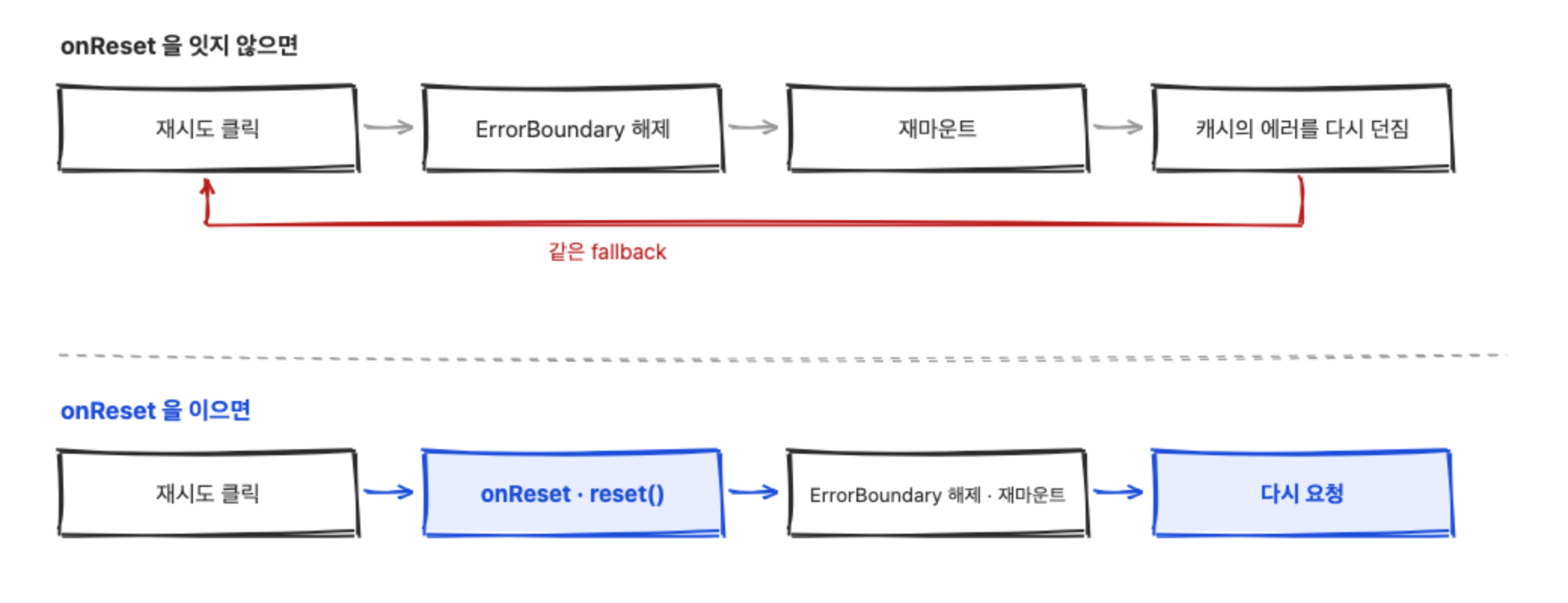
retryOnMount is turned off only for a query lifted into an ErrorBoundary, and that is why you have to clear the ErrorBoundary and the query together. What raises the flag that isReset() reads is QueryErrorResetBoundary. Open the source and the state is a single boolean.
reset: () => {
	isReset = true;
},
If the flag were only ever raised and nobody lowered it, later errors would not turn off retryOnMount either, and every one would request again. The one that lowers it is the query hook. The remounted hook reads the flag during render and does not turn off retryOnMount. getHasError, which looks at the same flag, does not throw the cached error either. Then, after it is attached to the screen, it lowers the flag in an effect. The function lives in the same errorBoundaryUtils.js.
const useClearResetErrorBoundary = (errorResetBoundary) => {
	React.useEffect(() => {
		errorResetBoundary.clearReset();
	}, [errorResetBoundary]);
};
So a single boolean is enough to mean retry just this once. In order, one retry goes like this:
reset()raises theisResetflag.- The remounted query hook sees the flag during render and does not turn off
retryOnMount. - With the flag raised, the hook sees a pending state instead of the cached error and requests again (
useSuspenseQuerysends the request during render and suspends). - If the request succeeds and the component is attached to the screen,
clearReset()in an effect lowers the flag; if it fails again, that request'scatchlowers it. - With the flag lowered, later errors turn off
retryOnMountagain.
You connect this reset to the ErrorBoundary's onReset. TanStack Query's docs and source comments also show code that connects them this way as an example.
export function QueryAsyncBoundary({ children, pendingFallback }: Props) {
  return (
    <QueryErrorResetBoundary>
      {({ reset }) => (
        <ErrorBoundary
          onReset={reset}
          fallbackRender={({ error, resetErrorBoundary }) => (
            <ErrorFallback error={error} onRetry={resetErrorBoundary} />
          )}
        >
          <Suspense fallback={pendingFallback}>{children}</Suspense>
        </ErrorBoundary>
      )}
    </QueryErrorResetBoundary>
  )
}
Here is how react-error-boundary implements resetErrorBoundary. It is a built file so the names are down to one letter, but the structure still reads.
resetErrorBoundary(...e) {
  const { didCatch: t } = this.state;
  t && (this.props.onReset?.({ args: e, reason: "imperative-api" }), this.setState(d));
}
Only when didCatch is true does it call onReset and set the state back to the initial value d (didCatch: false). setState renders after the handler finishes, so by the time the children remount, the flag that reset() raised is already up. That is why it is enough to wire onReset to reset.
Even without wrapping in QueryErrorResetBoundary, if you take useQueryErrorResetBoundary() and pass its reset to onReset, retry works. With no enclosing boundary, the hook returns a module-global default. The cost, as the Suspense guide notes, is that the reset applies globally and the whole app shares one isReset flag.
The render error reset cannot clear
The second is when the server returns a 200 with a shape other than the one you expected, and the render that reads it throws a TypeError. The same ErrorBoundary received it and onReset is wired, yet retry does nothing.
What reset clears is a query in an error state. But this query succeeded. The server gave a 200 and the cache holds that value as normal data. What produced the error was the render that read it. So reset has nothing to clear, and the remounted component reads the same cached value during render and throws again on the same line. Because it throws before it is attached to the screen, it never gets to subscribe to the query. That is why it does not request again even with staleTime set to 0. This query too is removed from the cache once gcTime passes and is requested again, but as long as the server sends the same value it throws again on the same line.
The place to fix it is queryFn.
queryFn: async () => {
  const res = await fetch(`/api/posts/${postId}/comments`)
  const data = await res.json()
  if (!Array.isArray(data.comments)) {
    throw new TypeError('comments 가 배열이 아니다')
  }
  return data.comments
},
On a fetch response, json() returns Promise<any>, so a type you attach after it is a declaration, not a check, and the runtime check that verifies what the server sent has to be put in yourself. Lift that check up into queryFn and the same failure becomes the query's error. It stays in the cache in an error state, reset clears it, and retry refetches.
If you put the runtime check off because the ErrorBoundary catches it anyway, you get a fallback that receives but cannot undo.
The lazy only a reload clears
The third is a chunk load failure. This time neither reset nor queryFn is involved. What holds the state is lazy itself.
React's lazyInitializer writes the rejection into payload and from then on throws the same thing every time.
throw payload._result;It does not import() again. The lazy() call happened once at module top level, and that payload stays as it is for the life of the app. Release the ErrorBoundary and remount, and the same error comes back.
Then why not create a new lazy and call import() again? Until now the browser blocked that. The module map remembered the failed result and did not fetch the same URL again. An HTML spec change that changes this was merged on 2026-07-15. Engine status as checked on 2026-10-08: Firefox shipped it in 155, released 2026-09-01. WebKit landed it in main on 2026-08-19, and the bug record does not name a stable Safari release that includes it. Chrome is still Proposed on chromestatus. So in Chrome, a fresh import() returns the same failure.
This applies to builds that load chunks with the browser's native import(), such as Vite. The webpack runtime loads chunks with script tags and clears the record of a failed chunk, so calling it again through a new lazy requests it again.
Either way, a lazy you already created does not try again, so the default recovery from this failure is fetching the page again. Even once browsers do refetch, not every case clears. A chunk load failure can come from a dropped network, or, as the Vite docs explain, from a new deployment deleting the old chunks. A deleted chunk is still missing when requested again, so in that case recovery is still a reload. Since you cannot pin down a single cause, the fallback text is better off suggesting a reload than asserting that a new version is out.
In short, a query error is cleared with reset, a render error by turning it into a query error in queryFn beforehand, and a chunk failure by reloading.
Wrapping up
If a retry button does nothing, I hope you will check what threw and where its state is still held before looking at the button or the ErrorBoundary. Where you clear it depends on whether it is the query cache, the render that read what the server sent, or lazy.
Where on the screen to put ErrorBoundary and how many, and which failures should not get a retry button at all, are covered in Placing ErrorBoundary.