MCP and Function Calling
In this post, I want to talk about how MCP (Model Context Protocol) differs from function calling.
This is for developers who use MCP servers with Claude Code or Cursor but have found it hard to explain where MCP parts ways with the function calling in LLM APIs. The short answer is that MCP does not replace function calling. The host application converts the tool list it receives from an MCP server into the tools parameter of function calling, and passes the call the model chooses back to the MCP server. By the end, you will know which part of the protocol each of the four differences MCP adds on top comes from, which differences survive the 2026-07-28 revision, and what attack surface that structure opens.
I work as a frontend developer and use Claude every day, yet each time I added another MCP server, I was never quite sure how these tools actually entered the model's field of view.
MCP (Model Context Protocol)
MCP (Model Context Protocol) solves the question of “what should we enable the agent to do?”
Put more concretely, an AI agent needs to be able to call the Slack API to send a message to Slack. It needs to call the GitHub API to create a GitHub issue. It needs to handle a database connection to query Postgres. MCP unifies integrations with all these external systems under a single standard protocol. (The point is that clients and servers connect through the same specification.)
MCP is an open standard first released by Anthropic on November 25, 2024. Then, on December 9, 2025, Anthropic donated MCP to the Linux Foundation’s Agentic AI Foundation (AAIF). The AAIF was co-founded by Anthropic, Block, and OpenAI.
MCP is a protocol built on JSON-RPC. JSON-RPC 2.0 is a stateless, lightweight RPC (Remote Procedure Call) protocol that uses JSON as its wire format. It is transport-independent and can run over HTTP, TCP, or standard input/output. This post describes the 2025-11-25 revision, in which MCP is a stateful protocol that sets up a session for each connection. What changed in the revision after that is covered once we have walked through the call flow.
Six Primitives
The overview of the 2025-11-25 specification lists three features that servers offer and three features that clients offer. This post calls these six primitives. Here, a primitive has nothing to do with JavaScript's primitive types (such as string or number); it refers to a basic type of interaction defined by the protocol.
Server-side primitives
- Tool (model-controlled): an action the model autonomously decides whether to invoke. Such actions may have side effects
- Resource (application-controlled): data identified by a URI. The specification only has
resources/readfor reading its contents and no method for writing. How those resources go into the context is decided by the host application - Prompt (user-controlled): a reusable template explicitly triggered by the user, for example through a slash command
Client-side primitives
- Sampling: a mechanism that allows the server to request a completion from the client’s LLM, making the client-server architecture bidirectional. It lets a server that needs generated text while running a tool borrow the model the client uses, without an API key of its own. It was deprecated, that is, scheduled for removal, in the 2026-07-28 revision.
- Roots: workspace boundary information through which the client tells the server, “This is the extent of the area you may work in”
- Elicitation: a feature that allows the server to request additional user input in a structured form while executing a tool
This distinction matters because who decides to invoke or provide something differs. A Tool runs at the model’s discretion, so an incorrect invocation carries risk, while a Prompt is explicitly chosen by the user. A Resource is chosen by the application by default, but the specification also allows implementations that include resources automatically, based on heuristics or the model’s selection. The three client-side primitives run in the opposite direction: the server asks, and the client decides whether to respond.
Two Transports
There are two standard transport mechanisms, and the specification also allows other custom transports (MAY). The first is stdio, which runs an MCP server as a local subprocess and communicates through standard input and output. It is well suited to locally operating tools such as filesystem and git integrations. The second is Streamable HTTP, which layers SSE (Server-Sent Events) streaming over HTTP POST and GET to create near-bidirectional communication. SSE is a way for a server to push data to a client in one direction over an HTTP connection. It is suited to scenarios that occur across a network boundary, such as remote servers, OAuth authentication, multi-client connections, and cloud deployments.
How an LLM Invokes an MCP Tool
Now that we have covered the primitives and transports, let us trace how an LLM actually discovers and invokes an MCP tool.
In the 2025-11-25 revision, the following handshake takes place when a connection begins. As of 2026-10-08, the TypeScript SDK’s 1.32.1 and the v2 line’s 2.3.1 also follow this order in their default configuration.
- Client → server:
initializerequest (sends the supported protocol version and client capabilities) - Server → client:
initializeresponse (server capabilities plus an optionalinstructionsfield) - Client → server:
notifications/initializednotification - Client → server:
tools/listrequest → receives the list of available tools - (Later) The LLM decides to invoke a tool → the client sends
tools/call→ receives the result
The initialize response’s instructions field is where the server sends text describing how its tools should be used. The instructions line in the demo output below shows this value.
How, then, does the tool definition itself enter the LLM’s field of view? An MCP tool definition takes the following JSON Schema form.
{
  "name": "get_weather",
  "description": "Get current weather information for a location",
  "inputSchema": {
    "type": "object",
    "properties": { "location": { "type": "string" } },
    "required": ["location"]
  }
}
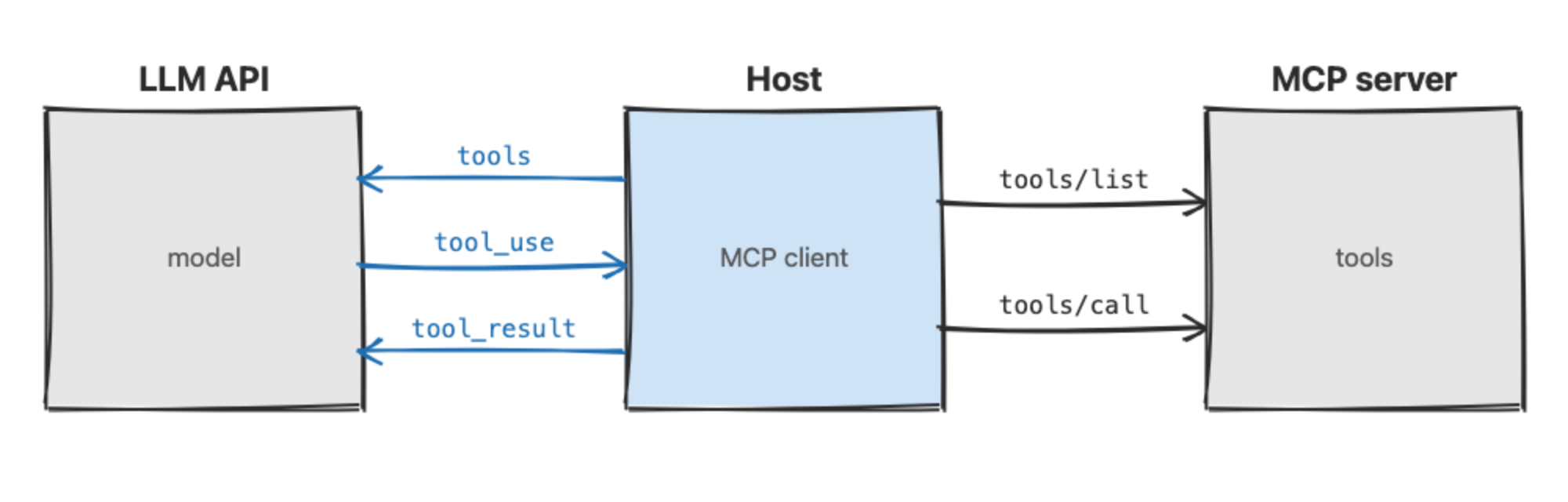
The host transforms the list returned by tools/list into the tools parameter of the Anthropic Messages API or the tools parameter of OpenAI function calling, then includes it in the LLM API request. With Anthropic, supplying the tool parameter automatically adds a special system prompt that teaches the model how to invoke tools. Its length varies by model. In the documentation table I checked on 2026-10-08, current models added 286 to 675 tokens with tool_choice: auto.
When the LLM decides that it should invoke a tool, its response contains a tool_use block ({"type": "tool_use", "name": ..., "input": ...}), and the response ends with a stop_reason of tool_use. The host receives this, sends tools/call to the actual MCP server, receives the result, places it in a tool_result block in the next user message, and sends it back to the LLM. This loop continues until stop_reason changes from tool_use to another value, such as end_turn or max_tokens. What we commonly describe as “the agent working” is essentially a sequence of these call-result-call loops.
Drawn as a picture, there is no line between the model and the MCP server. The model only sees the definitions it received through tools, and the MCP server receives requests from the host, not from the model. What connects the two protocols is the host in the middle.
I ran this conversion to see how short it really is. It ran on 2026-10-08 with Node v24.16.0, @modelcontextprotocol/sdk 1.32.1, and zod 4.6.5. Instead of stdio, the transport is InMemoryTransport, which connects the server and client inside one process, and no LLM was called. The tool_use block was built by hand in the shape shown in Anthropic’s documentation.
import { McpServer } from "@modelcontextprotocol/sdk/server/mcp.js";
import { Client } from "@modelcontextprotocol/sdk/client/index.js";
import { InMemoryTransport } from "@modelcontextprotocol/sdk/inMemory.js";
import { z } from "zod";

// MCP 서버: 도구 하나와 instructions 를 둔다
const server = new McpServer(
  { name: "weather", version: "1.0.0" },
  { instructions: "Use get_weather for current conditions only." }
);
server.registerTool(
  "get_weather",
  { description: "Get current weather information for a location", inputSchema: { location: z.string() } },
  async ({ location }) => ({ content: [{ type: "text", text: `${location}: 15C, partly cloudy` }] })
);

// 호스트: 같은 프로세스 안에서 서버와 잇고, 클라이언트가 보내는 메서드 이름을 찍는다
const [clientT, serverT] = InMemoryTransport.createLinkedPair();
const send = clientT.send.bind(clientT);
clientT.send = (m) => { console.log("C->S", m.method, m.params?.protocolVersion ?? ""); return send(m); };
await server.connect(serverT);
const client = new Client({ name: "demo-host", version: "1.0.0" });
await client.connect(clientT);
console.log("instructions:", client.getInstructions());

// 1. tools/list 결과를 LLM API 의 tools 파라미터 모양으로 바꾼다
const { tools } = await client.listTools();
const anthropicTools = tools.map((t) => ({ name: t.name, description: t.description, input_schema: t.inputSchema }));
const openaiTools = tools.map((t) => ({ type: "function", name: t.name, description: t.description, parameters: t.inputSchema }));
console.log("anthropic:", JSON.stringify(anthropicTools[0]));
console.log("openai:", JSON.stringify(openaiTools[0]));

// 2. 모델이 이런 tool_use 블록을 돌려줬다고 가정한다. input 이 그대로 tools/call 의 arguments 가 된다
const toolUse = { type: "tool_use", id: "toolu_demo", name: "get_weather", input: { location: "Seoul" } };
const result = await client.callTool({ name: toolUse.name, arguments: toolUse.input });
console.log("tool_result:", JSON.stringify({ type: "tool_result", tool_use_id: toolUse.id, content: result.content }));
await client.close();
The output of node post-demo.mjs is as follows.
C->S initialize 2025-11-25
C->S notifications/initialized
instructions: Use get_weather for current conditions only.
C->S tools/list
anthropic: {"name":"get_weather","description":"Get current weather information for a location","input_schema":{"type":"object","properties":{"location":{"type":"string"}},"required":["location"],"$schema":"http://json-schema.org/draft-07/schema#"}}
openai: {"type":"function","name":"get_weather","description":"Get current weather information for a location","parameters":{"type":"object","properties":{"location":{"type":"string"}},"required":["location"],"$schema":"http://json-schema.org/draft-07/schema#"}}
C->S tools/call
tool_result: {"type":"tool_result","tool_use_id":"toolu_demo","content":[{"type":"text","text":"Seoul: 15C, partly cloudy"}]}
Converting the tool definition is nothing more than renaming fields. MCP’s inputSchema becomes input_schema in Anthropic and parameters in OpenAI. The output also shows that the SDK adds $schema to the schema. The other direction is just as short. Anthropic’s tool_use.input is an object, so it goes straight into tools/call as its arguments. On the result side, text blocks have the same shape and pass straight through, but image and error results have a different shape, so the Anthropic SDK’s MCP helper converts them separately. The OpenAI shape above is the Responses API format. The arguments of a call OpenAI returns is a JSON-encoded string, so it needs one pass through JSON.parse before being handed over. The code above builds only an Anthropic-shaped tool_use block, so this parse step does not appear in the output.
Four Things MCP Adds
So what does MCP add to function calling? Under the 2025-11-25 revision, there are four things.
- Dynamic discovery: the tool list is retrieved at runtime through
tools/listrather than known at build time. The server can announce throughnotifications/tools/list_changedthat the list has changed during a connection - Stateful session: a connection is established with
initialize, and requests are exchanged within it. There is no dedicated JSON-RPC shutdown message; the session ends by closing the transport - Primitives beyond Tool: Resource, Prompt, Sampling, Roots, and Elicitation are exposed through capability negotiation. Capability negotiation is the step in
initializewhere each side announces the features it supports - Bidirectionality: the server can request a completion from the client’s LLM in reverse through Sampling (deprecated in the 2026-07-28 revision)
After the 2026-07-28 Revision
As of 2026-10-08, the revision the official site opens as latest is the 2026-07-28 revision, and half of this list changed there. First, the handshake made of initialize and notifications/initialized and protocol-level sessions are gone. Instead, every request carries the protocol version and client capabilities in _meta. That field is a slot MCP reserves for attaching metadata alongside a message’s regular parameters. Servers MUST implement server/discover. It is an RPC that returns the server’s supported protocol versions, capabilities, and server information, and a client can call it before any other request to check the supported versions and capabilities up front.
Requests the server used to send first were replaced by a pattern called Multi Round-Trip Requests (MRTR). Instead of sending a separate request, the server returns an interim result saying it needs more input (input_required), and the client fills in that input and sends the original request again.
Sampling and Roots were deprecated along with Logging. They remain in the specification and still work, but new implementations should not adopt them, and the specification recommends integrating directly with LLM provider APIs instead of Sampling.
The SDKs’ default behavior, however, still follows the old way. TypeScript SDK 1.32.1 has 2025-11-25 as its latest version constant and does not know the 2026-07-28 revision, and 2.3.1 supports this revision but defaults to legacy version negotiation. The first line of the output above, initialize 2025-11-25, is the result.
What remains of the four, then, is dynamic discovery and the primitives beyond Tool (Resource, Prompt, Elicitation). Dynamic discovery has changed shape slightly as well: list change notifications go only to clients that opt in to the subscriptions/listen stream. In the end, where MCP parts ways with function calling is less about sessions or bidirectionality and more about a contract for exchanging the tool list and context at runtime.
When the API Becomes the MCP Client
Anthropic’s MCP connector (beta) shows how much of this contract reaches the model. It is a feature in which the Messages API connects directly to a remote MCP server, and the Limitations section of its documentation says that of the MCP specification’s features, "only tool calls are currently supported", and that "Local STDIO servers cannot be connected directly". The same documentation advises that if you need local servers, MCP prompts, or resources, you manage the connection yourself with an MCP SDK and use the Anthropic SDK’s conversion helpers.
In other words, when MCP is consumed at the function calling layer, only Tool remains. Resource and Prompt mean something only when there is a host to carry them into the screen or the context. OpenAI’s function calling guide also introduces a way to use the functionality of an MCP server as a built-in tool. OpenAI’s MCP servers guide describes only how to list and call tools, and does not say whether Resource or Prompt is supported.
The Attack Surface Dynamic Discovery Opens
Tool descriptions and tool call results pass through the host into the model’s context. So whatever a server writes there, the model reads. Both representative attacks come from this.
-
Tool Poisoning Attack (TPA): an attack named and demonstrated in a PoC by Invariant Labs in April 2025. If malicious instructions are hidden inside an MCP server’s tool description, the model reads that text, which the user never sees, and may follow it without the user knowing.
-
Rug Pull: an attack, described by Invariant Labs in the same post, in which the server changes a tool definition after the user has approved it. As in Elena Cross's example quoted by Simon Willison, you approve a safe-looking tool on day 1, and by day 7 that tool has been changed to send your API keys to an attacker; it happens because tool definitions are fetched from the server at runtime rather than at install time. The tool specification recommends (SHOULD) UI that shows which tools are exposed to the model but does not require re-approval of a changed definition, so re-approval falls to the host.
Wrapping Up
In short, MCP does not replace function calling; it is a standard layered on top of it. The model still invokes tools through the tools parameter and the tool_use loop, and the host translates between the two protocols. In the 2025-11-25 revision, what MCP added was dynamic discovery, a stateful session, primitives beyond Tool, and calls that go from the server to the client. With sessions gone and Sampling deprecated in the 2026-07-28 revision, what remains is a contract for exchanging the tool list and context at runtime. Because of that contract, attacks that poison tool definitions or quietly change them arise in the same place. When you add another MCP server, I recommend checking not only what that server can do but also whether your host tells you when its definitions change.
If MCP is about what to enable the agent to do, what to tell the agent is the job of context files such as CLAUDE.md and AGENTS.md. How those files are read by the agent, and how far their instructions are followed, is covered in Context Files.